


Story Background
Dora Minor, a quirky and fiercely courageous girl, grows up in a remote Virginia mountain community in a family of outliers, thanks to their Quaker beliefs that all people are born equal. After her mother’s death, her indomitable, pipe-smoking grandmother Alma—a revolutionary in her own right—becomes her primary caregiver and protector. With a fierce moral compass, Alma helps shape Dora’s worldview and guides her to question the status quo.
When Dora’s father partners with formerly enslaved Ginny Dudley to open a school for Black children in a place where none would otherwise exist, it sparks a violent backlash. After her father’s death and then a lynching, Dora, with Alma at her side, are forced to look at their community in a new light. Alongside Ginny’s husband Randolph and her closest friend Watcher James, a preacher guided by Nature spirits, Dora confronts hard truths about her neighbors, her father’s death, and, finally, the mysteries of her mother’s life—all of which ultimately leads to healing.
A post–Civil War novel that opens just as Reconstruction is falling apart, What the Trees Remember depicts a time of extreme social unrest and the birth of the Jim Crow era as experienced by strong women constrained by the limitations of the time they live in. Through the devastating loss of loved ones, the destruction of the comfortable life they’ve known, and Nature’s wrath, Dora and Alma strive to rise above their trials by drawing strength from the natural world and never losing faith in themselves.
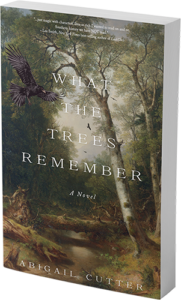
Praise for What the Trees Remember
“This book is just magic with characters so alive on the page, their lives so rich and full, I just want to read on and on. This is major Southern history we have NOT read—a fascinating new history, people, and themes.”
~ Lee Smith
New York Times best-selling author of The Last Girls
“The book reminds readers that the American South was never monolithic, and that those who keep their hearts open to others may reap the kind of profits that can’t be found in a bank. This story of indomitable women will find fans who love books by Kathleen Grissom and Sue Monk Kidd.”
~ Kirkus Reviews
“This is a novel for readers who love Southern historical fiction. It doesn’t flinch from ugly history, but there’s warmth, humor and a hopefulness running through it.”
~BookTrib.
“The novel’s honest relationship with consequence is what distinguishes it from more romanticized historical fiction. …What lingers after the last page is the mountain itself: its seasons, its flooding creek, its headwaters where Watcher James prays among the moss. Cutter has written a book that understands landscape as memory. The trees in the title aren’t a metaphor. They’re witnesses.”
~ Seattle Book Review
“What the Trees Remember is a novel of real depth, rooted in a specific American geography that it refuses to flatten.”
~ Tulsa Book Review
“Full of wisdom and beauty, this is the kind of deep and propulsive story that sticks with you long after you finished reading it. Cutter tackles the thorny issues of a post Civil-War South with intelligence and generosity. The people and the geography come alive in her capable hands. This story speaks directly to our times and will leave you hopeful that we can in fact build a better world through education and empathy.”
~ Katrin Schumann
Washington Post best selling author of The Forgotten Hours
“Part mystery, part coming-of-age story, and part meditation on history, survival, and the natural world, What the Trees Remember is a deeply researched and emotionally resonant novel that will especially appeal to readers who enjoy atmospheric historical fiction with strong social commentary.”
~ NetGalley Review
“Cutter’s commitment to authentic regional voice, to showing consequence without editorializing, and to characters who earn their complexity the honest way keeps the novel on solid ground from first chapter to last. What the Trees Remember is strong, honest, and worth the investment.”
~ San Diego Book Review
“This book is deeply satisfying historical fiction that handles a big canvas with warmth and skill. Hand it to anyone who loved Cold Mountain or The Known World.“